

Precision in pixels: your data centre site unboxed
Finding the ideal location for your data centre or industrial project can be a complex challenge. At datacenterlandsites.com, we understand your biggest worries and have developed our 'DD Tools' to provide clarity and confidence. Discover how we address every critical factor to ensure your site is perfectly positioned for success.
Demystifying site selection with DD tools
Our 'DD Tools' represent a unique, comprehensive approach to site vetting. They are a suite of free GIS mapping tools and a powerful viewer, meticulously designed to evaluate every potential site against AL’s 10 Ps for AI-Ready Site. This isn't just a checklist; it's an interactive way to ensure a site is not just good, but perfect for your high-load operations.
Explore the 10 ps with our interactive mapping tools
Dive deeper into each critical 'P' with our complimentary GIS mapping tools. Visualize the data that de-risks your next data centre or industrial project. Our tools provide the detailed insights you need to make informed decisions for your power-ready land site.
The ultimate peace of mind: de-risking your investment
The main benefit of our 'DD Tools' is the profound peace of mind they offer. By thoroughly evaluating every 'P', we provide the crucial insights needed to de-risk the entire site selection process. This meticulous due diligence empowers you to make informed decisions, ensuring your site in North Bay, Ontario, Canada, or beyond, is perfectly suited for long-term success and growth for your data centre or industrial operation. We bridge the gap between energy markets and real estate, making it easier to secure capacity and move fast.
Below guide covers all critical aspects necessary for a robust data center assessment.
Physical Infrastructure Evaluation
Many organizations depend on outdated legacy IT infrastructure, which can lead to inefficiencies and increased maintenance costs.
Aging equipment, poor layouts, improper cooling systems, and other physical issues can affect the data center’s overall reliability, increasing the risk of equipment failure and raising operational costs.
Other physical infrastructure considerations include:
- The data center’s location in relation to other server environments
- Accessibility of facilities
- Whether cabling can support the present and future needs of the center
Power and Cooling Efficiency
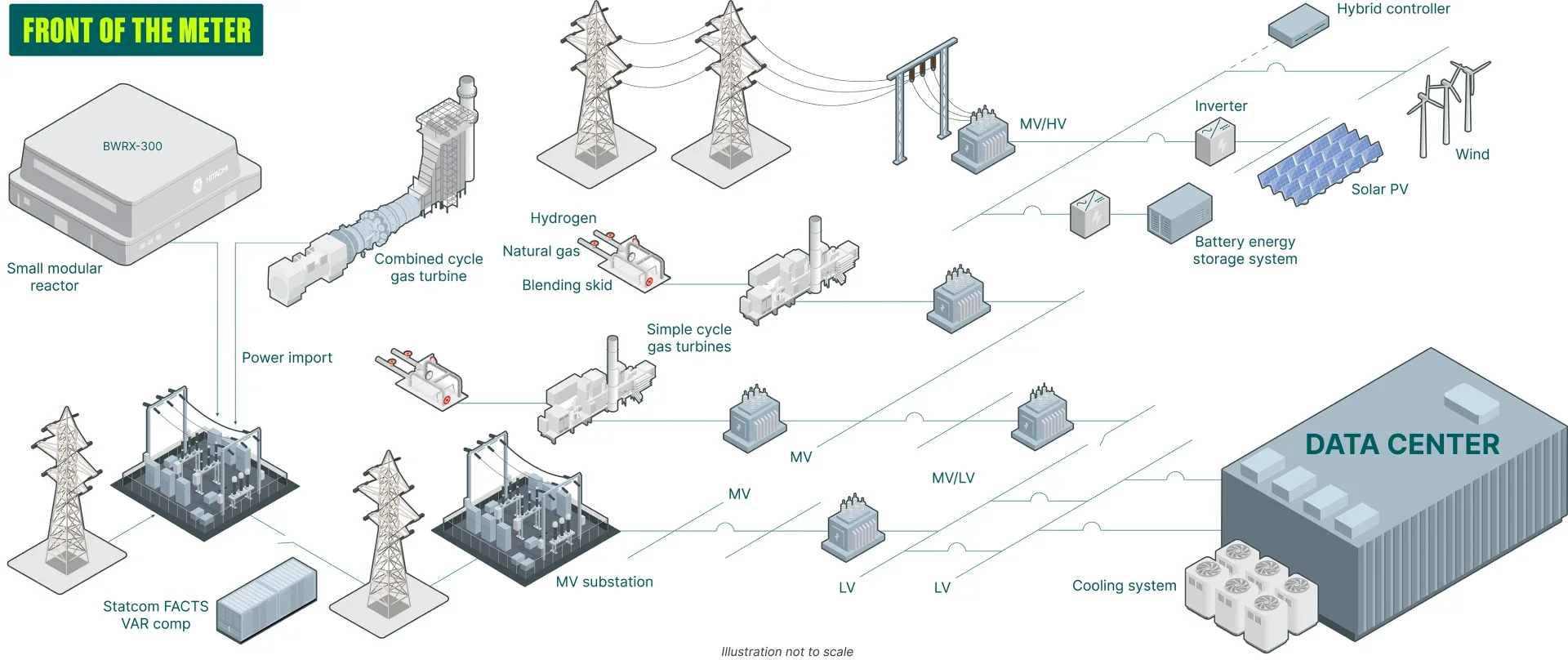
Data centers usually require far more cooling capabilities than regular office space in the same area. Assessing how well a center is cooled involves examining the capacity of the current cooling infrastructure and other considerations such as space, structural support, and air-conditioning capacity.
Systems that don’t provide the required level of cooling can lead to excessive energy consumption, higher operational costs, and damaged equipment.
A reliable power supply is, of course, another important consideration. Adequate energy capacity ensures that hardware requirements are accommodated and avoids downtime due to outages. Some of the important things to examine are:
- How much power is readily available?
- Is your infrastructure supported by enough electrical circuits?
- Do you have enough space to accommodate battery backup systems and standby generators?
Network Infrastructure Assessment
If your network infrastructure suffers from a poor design or outdated hardware and applications, this can cause bottlenecks and inefficiencies that cause poor performance. Streamlining your organization’s infrastructure can minimize downtime, revenue losses related to service interruptions, and user frustration.
A network infrastructure assessment can include:
- A hardware and software evaluation
- An assessment of the network setup, including cables, routers, firewalls, and Wi-Fi access.
- Identifying risks that could interrupt the provision of services
Security Measures Review
Data center security involves protecting your facilities and people from cyberattacks and other threats, including ones to applications and data. If you have security vulnerabilities, you leave yourself open to data loss, regulatory fines, and damage to the company’s reputation and, perhaps, property.
When you assess your data center, you should consider three essential levels of protection:
- Providing complete visibility into all the different users, devices, networks, applications, workloads, and processes helps speed up detection and responses to cyber threats.
- Using segmentation to minimize the possibility of an attack spreading throughout a data center.
- Developing comprehensive threat protection using state-of-the-art cybersecurity applications and raising staff awareness about dealing with issues. The security policies should follow the complete workload chains across physical and virtual environments.
Disaster Recovery and Backup Plans
Data has become one of the most important and sensitive resources in organizations. A data breach gone unchecked can lead to excessive downtime and business disruptions, possibly causing loss of critical data, regulatory and compliance issues, financial losses, and long recovery times that can damage business continuity.
A physical disaster such as a fire or flood that destroys your technology can pose similar dire consequences.
So, it is essential to have a comprehensive disaster recovery and backup plan in place. These can include, among other things:
- Making a detailed inventory of hardware and software assets
- Having a communications plan in place to contact all stakeholders in the event of an emergency
- Backing up all data and applications to one or more secure, remote locations.
- Developing a plan to quickly reestablish access to data, applications, and other resources, minimizing downtime.
- Making a prioritized list of recovery tasks assigned to specific team members
Compliance and Regulatory Adherence
Data centers handle vast amounts of critical data and are required to safeguard it. To ensure this, governments and agencies enforce various compliance and regulatory frameworks, such as the General Data Protection Regulation (GDPR), the Health Insurance Portability and Accountability Act (HIPAA), and the NIST Cybersecurity Framework.
Non-compliance with these regulations can result in fines, legal problems, audits, and loss of reputation.
So, it is up to individual organizations to stay atop the constantly evolving web of regulations, ensure third parties they do business with are also compliant, and, in some cases, store data in specific geographic locations. Staying compliant can also involve rigorous documentation, reporting, and audits of your efforts.
Future-Proofing and Scalability
As the name suggests, future-proofing is about anticipating challenges and changes down the road and developing plans to minimize problems that can hurt your business operations.
Scalability needs to be built into your network to expand as your business does. One approach is to forgo the single huge data center and take a modular approach, setting up a series of smaller centers, with one opening as the next is being built.
Data center designs must also reflect the rising demands of machine learning (ML), artificial intelligence (AI), and high-performance computing so that they can effectively harness these increasingly important technologies.
Sustainability might be part of your future-proofing process. These would anticipate the growing body of regulations covering carbon emissions, energy use, and other environmental concerns.
NOAA
NOAA
Homeland Infrastructure Foundation Level Database
Esri and Impact Observatory
World Database of Protected Areas
Esri Canada
Copernicus Atmosphere Monitoring Servicr
Add comment
Comments