

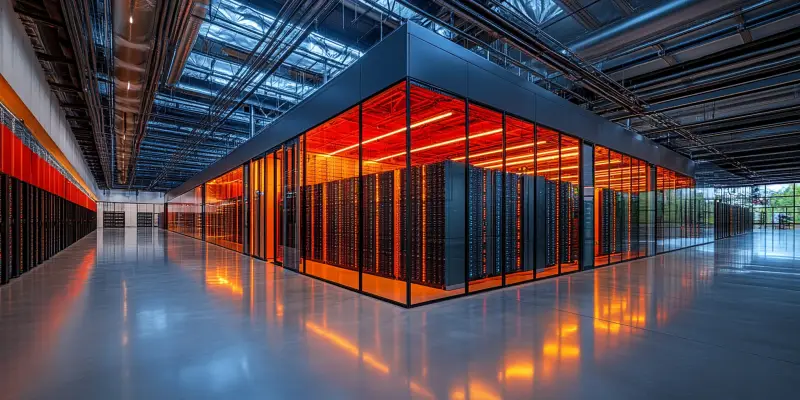
Data Centre Development in USA & Specially Texas
At DataCenterix, we specialize in coordinating efforts for data centre development achievable, efficient, and future-proof. Building a data centre is a complex undertaking, from initial site selection to final commissioning. We navigate these intricacies, providing an in-depth guide and a committed partnership to ensure your facility not only meets today's demands but is also prepared for tomorrow's innovations. Discover how we transform raw land into high-potential, power-ready data centre sites.
Organizations seeking to increase data center capacity can choose from several options: building a new facility, expanding the capacity of an existing data center through new construction, retrofitting another type of building to become a data center, leasing dedicated capacity from a third-party data center provider, or utilizing colocation services. The most optimal choice depends on the specific needs and objectives of the organization, not just a binary decision between constructing a data center or exclusively outsourcing to a service provider.
Building a data center is the process of constructing a facility to house computer systems, storage, and IT equipment for data handling. It involves building the physical infrastructure, including space, power, and cooling, to support the critical technology inside these specialized facilities.
This article focuses on building a data center, including the actual process of constructingthe physical infrastructure, once the design phase is complete. Dgtl Infra has previously discussed data center design, which primarily concerns planning the layout and conceptual elements of a facility, as well as the site selection process and considerations that should be given to the location of the data center. The build phase transitions these theoretical design concepts into a fully operational facility.
Evolution and Expansion of Data Center Construction
Data centers, due to their technical and operational complexities, require significant coordination and customization during construction. The substantial capital costs associated with their development, often reaching hundreds of millions to $1 billion for a single campus, further underscore the importance of this planning. Before construction, it’s essential to determine the data center’s size and capacity, which can be gauged by the number of racks, the building’s square footage, or its power capacity in megawatts.
Increasingly, data centers are expanding in size and power capacity. A data center that spans 100,000 square feet and has 25 megawatts of power capacity was once considered large. Presently, it’s not uncommon to see facilities exceeding 250,000 square feet and supporting 80 megawatts, 100 megawatts, or even multiple hundreds of megawatts in power capacity.
Constructing these massive data centers is a lengthy endeavor. The entire process, which includes engineering, materials procurement, civil works, equipment installation, and commissioning tests, often takes anywhere from 1.5 to 3 years. At the height of construction, it’s not unusual for such projects to employ over 1,000 construction workers on-site temporarily.
Who is Building Data Centers?
Multinational corporations such as Amazon Web Services (AWS), Microsoft Azure, Google Cloud, Meta Platforms, Equinix, and Digital Realty are constructing data centers worldwide. These top data center companies are adding nearly 50 million square feet and over 1 gigawatt of capacity globally. The expansion of data centers is vital to handle the surge in internet traffic, support advancements in technologies like artificial intelligence (AI), and strengthen resilient digital infrastructure for global economies.
Pre-Construction Preparations
The pre-construction phase of a data center begins after the site selection and design phases are complete. At this stage, the data center’s layout and conceptual elements have already been mapped out, and an appropriate location has been selected.
The following discussion pertains specifically to the construction of a “purpose-built” data center. This means that construction starts from a raw, undeveloped piece of land, with the intent from the outset to establish a data center. This approach is often referred to as a ground up “greenfield” data center development. It contrasts with a retrofitted or “brownfield” data center, where an existing building, like a factory, is repurposed to function as a data center.
Construction Documents
Construction documents (CDs) provide a comprehensive and detailed set of specifications and drawings for how the data center will be built. These architectural, structural, and MEP (mechanical, electrical and plumbing) drawings are essential not only for the construction phase but also for obtaining necessary permits and approvals from local authorities. Construction documents for data centers are particularly crucial due to the facility’s complex requirements in terms of power, cooling, security, and IT equipment.
Entitlements and Building Permits
Entitlements for data centers involve securing the legal rights to develop a property specifically for data center use. This often requires approvals for power consumption, cooling infrastructure, and network connectivityneeds. The process may involve rezoning, especially if the current zoning does not allow for data center operations. Environmental reviews and assessments of potential impacts on local utilities and infrastructure are also essential to ensure that the facility aligns with local regulations and community interests.
Once the land has the appropriate entitlements, and a data center developer decides to proceed with construction, they must secure building permits from the local jurisdiction. These permits ensure that the construction adheres to local codes regarding safety and structural integrity. At this stage, detailed construction plans, blueprints, and specifications undergo review by local officials.
Due to the large physical footprint and significant power consumption of data centers, they require increased interaction with local authorities and communities. Thus, accommodating local nuances, such as noise requirements and community benefits, becomes crucial to the permitting process.
Will-Serve Letters
A “will-serve letter” is a formal document issued by a utility company, confirming that it can and will provide the necessary utilities, such as electricity and water, to a proposed data center development project. Given that data centers are major consumers of electricity and water, this letter assures the developer that the utility has both the capacity and the infrastructure to deliver the required resources. The will-serve letter specifically outlines the quantity of resources – for instance, megawatts (MW) of power – that the utility company commits to supplying to the data center in that area.
Obtaining a will-serve letter may require approval from, or coordination with, local municipal bodies, especially if infrastructure upgrades, such as building new substations, are required.
Sourcing of Materials
The sourcing of materials for data centers during the pre-construction phase focuses on procurement and logistics. This involves obtaining the necessary materials in the specified quality and quantity, negotiating with suppliers, scheduling deliveries, and managing inventory. Essentially a component of supply chain management, the objective of this process is to ensure that the correct materials arrive at the construction site on time and are utilized as specified in the design phase.
Extended lead times can hinder the procurement of crucial materials and equipment, which might delay data center construction schedules and increase project costs. For instance, vital equipment like Uninterruptible Power Supply (UPS) systems, Power Distribution Units (PDUs), generators, switchgear & transformers, chillers, and Computer Room Air Handler (CRAH) units have recently experienced lead times of up to 12 months, or even longer for some pieces of equipment.
Site Preparation
Before the construction of a data center begins, the contractor will prepare the building site. The extent of this preparation depends on whether the site is raw land or a pad site. A pad site refers to a specific plot of land within a larger property, such as industrial or mixed-use parks, that’s designated for data center construction. Pad sites might already be prepped for data center construction, with established utilities and appropriate environmental conditions.
Assuming construction starts on a raw, undeveloped piece of land, site preparation includes the following steps:
- Land Clearing, Grading, and Leveling:This involves the removal of vegetation, debris, and any existing structures. It also ensures a flat and even surface for construction
- Utility Markings: This step is about identifying and marking the locations of existing utilities, like water, electricity, gas, or telecommunication lines, to prevent any disruptions
- Excavation and Groundwork: This involves soil testing, selecting the type of foundation, digging, and laying the groundwork for the planned data center
- Soil Compaction and Stabilization: This step ensures the ground is strengthened enough to support the weight of the data center
- Mobilization: This includes setting up temporary structures like the site office, storage areas, and assembling equipment to support the construction process. It also involves implementing site access controls and, if necessary, establishing temporary utilities
Building the Data Center
During the construction stage, the contractor executes the building work, bringing the project to life. In this phase, the plans and specifications from the data center design phase and construction documents are realized as the physical structure is erected. The focus is on constructing the building’s core, shell, and substations. Additionally, fuel storage tanks are installed, and the infrastructure and ancillary facilities are built out.
Core
The core of a data center comprises its foundational and primary structural components, typically constructed from a mix of concrete and steel.
The choice between concrete and steel comes with distinct advantages and disadvantages. Concrete offers superior thermal mass, fire resistance, vibration dampening, and resilience against natural disasters, often at a more affordable initial cost. On the other hand, steel provides a higher strength-to-weight ratio, which makes transport easier, and offers greater flexibility in data center design and future expansion. However, steel requires additional fire protection measures.
Key elements included in the core of a data center are:
Foundation Work
The building must be constructed to handle the weight, vibration, and heat dissipation of the data center equipment. Essential elements in the foundation include:
- Piling: For data centers requiring deep foundations, piles are either driven or bored into the ground to transfer the building’s load to a deeper, more stable layer of the earth
- Footings and Foundations: To accommodate the soil conditions and the load of the building, data centers typically utilize concrete slab foundations for their ability to distribute heavy loads. Raft foundations are preferred when soil conditions are challenging
Structural Work
Ensuring structural stability is crucial to protect the data center against various environmental threats, such as high winds, flooding, and the weight of accumulated snow and rain on the roof.
The primary structural skeleton of the data center consists of columns and beams, commonly referred to as the frame. Cranes often erect these support structures. Building a data center also requires slabs and walls which further enhance the strength of the structure:
- Columns: Erected using reinforced concrete or steel, these vertical structures transfer the data center’s load to the foundations
- Beams: These are horizontal structures that distribute the load from the slabs to the columns
- Slabs: Concrete floors are poured, either directly on the ground for the ground floor or onto shuttering for the upper floors, in the case of a multi-story data center
- Walls: Both external and certain critical internal walls are constructed. This might include load-bearing walls or curtain walls for non-load-bearing exteriors
Shell
The shell is the external envelope of the data center, enclosing both the core and the interior spaces. It offers protection against environmental elements and includes the roof, exterior walls, and waterproofing.
- Roofing: Installation of the roofing system to protect the interior from external environmental elements while supporting cooling and ventilation systems critical for temperature and humidity control
- Exterior Walls: The data center’s exterior walls are typically made of reinforced concrete or precast concrete panels to provide structural strength and security
- Waterproofing: Ensures that the facility remains free from water infiltration, protecting critical IT equipment and infrastructure from potential damage
Substations
A substation is a facility designed specifically to transform and distribute electrical power from the main utility source to the data center. It ensures the safe and consistent supply of electricity. These substations typically house equipment like transformers, switchgear, and protective devices to manage and condition power for the critical operations of the data center.
For large data center campuses, there’s often a need to construct new, and sometimes multiple, substations, especially if the data center aims to support hundreds of megawatts of IT capacity. To illustrate, a 100MVA substation operating at 13.2kV or 34.5kV could consist of multiple single-story units situated within a fenced compound on the site.
The timeline and process for constructing a new substation and its incoming connections largely depend on the electric utility company’s deployment capabilities since they are responsible for establishing this infrastructure. This can be a multi-year endeavor, especially in areas where there are limitations on power resources.
Fuel Storage Tanks
Fuel storage tanks are specially designed containers used to hold backup fuel, usually diesel, for data center emergency power systems. This ensures the continuous operation of the data center during power outages. Such tanks are vital for maintaining uninterrupted service and enhancing the data center’s resilience against external power disruptions.
For example, to operate at full load capacity for 48 hours, a large data center might need over 1 million liters of diesel fuel stored. These tanks are often double-skinned, bunded, and positioned above ground for added protection.
Infrastructure and Ancillary Facilities
To support the optimal operation of the data center and ensure the safety and functionality of its surroundings, several infrastructure components and ancillary facilities are integral. These include:
- Utilities: Electrical conduits, plumbing lines, sewage, ductwork for heating, ventilation, and air conditioning (HVAC) systems, and fire suppression systems
- Roadworks: Car parking spaces, loading docks, and an internal access road
- Drainage: Setting up proper drainage systems to prevent waterlogging
- Landscaping: Vegetation, tree planting, water features, and buffer plantings, which minimize the visual impact of the data center on surrounding communities
- Security: Physical security measures, including concrete barriers, gates, K12-rated perimeter fencing, berms, a security building with a guard situated at the site’s access/egress points, biometrics, and surveillance cameras to protect against unauthorized access
Project Management
Project management in data center construction involves the planning, organizing, and supervision of the project’s scope, schedule, and budget to ensure the timely and efficient completion of a data center facility. This process requires the coordination of multidisciplinary teams and contractors to ensure that the data center aligns with specific technical, operational, and business requirements.
Construction administration, a subset of project management, is the phase during which an architect or consultant oversees and manages the actual building process. This ensures that the project adheres to the documented plans, specifications, and quality standards. This phase involves coordinating with contractors and clients, conducting regular site visits, addressing contractor queries and submittals, ensuring compliance with codes and standards, and managing any issues or change orders that arise during the construction process.
Construction Methodologies and Strategies for Data Centers
Building a data center requires careful consideration of various construction methodologies and strategies to ensure efficiency, scalability, and sustainability in the face of increasing global data demands.
Construction Delivery Methods
When constructing a data center, there are various construction delivery methods that define the relationships between the owner, designer, and builder. The choice of model can have significant impacts on project cost, schedule, quality, and risk. Here’s a brief overview of the two most common models:
Design-Bid-Build
The design-bid-build (DBB) approach is the traditional method. The owner contracts separately with the design professional (architect/engineer) and the general contractor. The data center design is completed before the project is bid to construction firms. The design-bid-build approach offers a distinct separation of the design and construction phases, with greater owner control over data center design. However, it can be time-consuming, less collaborative, and costly for post-bidding changes.
Design-Build
In the design-build (DB) method, the owner contracts with a single entity, the design-builder, to provide both design and construction services for the data center. Using this method, there’s potential for quicker delivery and innovation due to overlapping design and construction activities and collaboration. However, the owner relinquishes some data center design control and must provide clear specifications given the significant responsibility placed on the design-builder.
Phased Builds
Phased builds in data center construction refer to the strategy of developing a facility in which new data halls and suites are added in stages or increments, rather than constructing the entire facility at once. This approach can also refer to the practice of building new data center facilities individually on a large, multi-building campus, as shown in the image below:
Phased builds allow for the initial deployment of a portion of the projected infrastructure, offering flexibility to expand as demand increases or as funding becomes available. This expansion can often be tied to securing a new tenant and their corresponding revenue, via a pre-lease, for a portion of the data center or a particular building on the campus.
By utilizing phased builds, companies can better manage capital expenditures (CapEx) and cash flow, adapt to technological advancements like a virtual data center, and scale infrastructure according to real-time requirements. This strategy helps avoid making large upfront capital expenditures and overprovisioning compute capacity, power systems, and cooling equipment.
Modular and Prefabricated Solutions
Modular and prefabricated construction for data centers involves the pre-assembly of key components or entire infrastructure modules in a controlled environment. Once assembled, they are then transported to the data center site for rapid deployment. This method provides significant benefits, including cost savings, shorter construction time, and consistent quality. It achieves this by standardizing components and substantially reducing labor-intensive on-site construction activities.
Modular data centers can reduce construction and deployment times by 40% to 50% compared to traditional data center building methods. For instance, NTT Global Data Centers can set up prefabricated data hall capacity in approximately 17 weeks, while CyrusOne can complete its modular data center hall construction in 12 to 16 weeks.
As a result, these data centers are highly scalable, allowing for quick capacity expansion with prefabricated modules as demand grows. They can also rapidly adjust power and cooling infrastructure to meet changing customer needs.
Multi-Story Buildings
Multi-story data centers stack data halls vertically over multiple floors, maximizing the utilization and density of a given footprint. This data center design is especially suitable for urban areas with limited land availability. In major data center hubs where land is at a premium, such as Ashburn, Virginia, these multi-story data centers are being built between two and five stories.
Building a data center vertically can substantially cut down on overall land acquisition costs, which, in markets like Ashburn, Virginia, can range between $1 million and $3 million per acre. However, multi-story data centers require meticulous planning for load distribution, vertical interconnects, and effective cooling solutions like liquid cooling. Specialized design is critical for this unique data center environment.
This model is gaining traction in densely populated regions where real estate prices are high and available plots are either small or irregular in shape. For example, in Singapore, Meta Platforms (formerly Facebook) is constructing an 11-story building on 12 acres of land in the Tanjong Kling Data Center Park.
Build-to-Suit Data Centers
Build-to-suit data centers are custom-constructed facilities designed specifically according to a client’s unique requirements and specifications. They allow for greater flexibility and optimization in terms of infrastructure, layout, and systems. In turn, build-to-suit methods ensure the data center aligns with the client’s operational needs and long-term business objectives, including potential future expansion. However, this approach typically requires more time to commission and a larger initial investment.
Sustainability
Sustainability in data center construction aims to minimize environmental impacts while optimizing resource efficiency. This can be achieved through the use of green building materials and energy-efficient infrastructure, ultimately reducing the facility’s carbon footprint.
One effective strategy is to carefully select building materials that have a minimal environmental impact, both during their production and throughout their lifecycle. Examples include using recycled steel, sourcing locally-produced concrete to cut down on transportation emissions, and opting for bio-based insulation materials instead of synthetic alternatives.
Data Center Construction Companies
Major data center construction companies and general contracting firms in the United States include: Turner Construction, Hensel Phelps, Whiting-Turner, Mortenson Construction, Holder Construction, HITT Contracting, Clune Construction, Suffolk Construction, DPR Construction, and Clark Construction.
These data center construction companies often operate within a “mission critical” segment, where they build essential infrastructure to ensure the continuous and reliable operation of core functions, an example of which is data centers. With the data center construction market growing at a rate of over 10% annually, the significance of their services is evident.
Many of the largest owners and operators of cloud data centers in the United States, including Amazon Web Services (AWS), Microsoft Azure, Google Cloud, and Meta Platforms, as well as colocation data center providers Equinix and Digital Realty, rely on these data center construction companies to build their facilities.
Cost to Build a Data Center
The cost to build a data center generally ranges between $600 and $1,100 per gross square foot or $7 million to $12 million per megawatt of commissioned IT load. For instance, constructing a 700,000-square foot, 60-megawatt data center in Northern Virginia – which is recognized as the world’s largest data center market – would require an expenditure ranging from $420 million to $770 million. This estimate includes the cost of the powered shelland the installation of critical electrical systems and HVAC components.
The costs for building a data center can be segmented into four principal categories:
- Land and Building Shell (15% to 20%):This includes costs for the building shell and raised floor
- Electrical Systems (40% to 45%): Major expenses in this category comprise electrical backup generators, batteries, power distribution units (PDUs), uninterruptible power supply (UPS) systems, as well as switchgear and transformers
- Cooling / HVAC Systems (15% to 20%):Key components here include the computer room air conditioning (CRAC) unit, computer room air handler (CRAH) unit, air-cooled chillers, and the infrastructure for chilled water storage and piping
- Building Fit-Out (20% to 25%): This category covers costs for the lobby or entrance, the meet-me room (MMR), and the shipping and receiving areas
Build vs Buy Decision
The build vs buy decision refers to the choice between constructing a custom enterprise data center from the ground up (build) versus leasing or purchasing space in an existing facility (buy). Building a data center allows for tailored infrastructure and data center design but often requires significant capital, time (typically 18 to 24 months), and expertise. On the other hand, buying or leasing offers faster deployment (usually under 6 months) and potential cost savings, but may limit customization and long-term scalability.
Colocation data centers often bridge the gap between the build and buy decisions. A colocation data center offers businesses the opportunity to rent space, power, and cooling within an existing facility, without the upfront capital and time investments of building from scratch.
Ultimately, constructing an enterprise data center demands specialized knowledge. It usually becomes commercially feasible at power capacities of 5 megawatts and above. Building facilities with capacities below this threshold often is not cost-effective, unless there are specific needs for on-premises infrastructure, such as edge data centers.
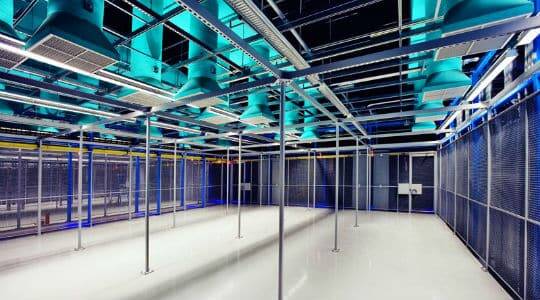
Streamlining your data centre build
The construction of a data centre involves intricate coordination and significant capital. Our approach focuses on delivering solutions that simplify this journey, ensuring your project progresses from concept to operational facility with confidence and control. We address the core pillars of successful data centre development.

Strategic site selection
Selecting the right location is paramount. We identify sites with optimal power availability, fibre connectivity, low natural disaster risk, and favourable zoning in regions like Texas & Nevada. Our due diligence minimizes risk and optimizes long-term operational performance, crucial for hyperscale and colocation facilities.

Power-ready infrastructure based on data center type
Power availability is outmost important in site selection based on type of data centers. Data centres are major consumers of electricity. We specialize in securing and coordinating high-capacity power solutions, including obtaining critical 'will-serve letters' from utility providers. This ensures your site can support the hundreds of megawatts needed for advanced AI and cloud data centres.
Types of Data Centers and Suitable Sites
- Enterprise Data Centers (Private): Owned and operated by a single organization for internal workloads.
- Suitable Sites: Corporate headquarters, on-premise, or dedicated, highly secure, purpose-built, and centrally located facilities.
- Colocation Data Centers (Shared): A third party owns the facility, providing space, power, and cooling to multiple clients.
- Suitable Sites: Urban areas or near metropolitan centers to provide easy access for clients to their infrastructure.
- Hyperscale Data Centers: Massive, scalable facilities designed for cloud providers (AWS, Google, Microsoft) and high-performance computing.
- Suitable Sites: Remote areas with cheap land, proximity to renewable energy sources, and ample access to water for cooling.
- Edge Data Centers: Smaller, decentralized, and located near users to reduce latency.
- Suitable Sites: Near cell towers, in dense urban neighborhoods, on top of office buildings, or near regional internet exchange points.
- Managed Services Data Centers: Operated by a third party, but the company leases the infrastructure rather than just the space.
- Suitable Sites: Connected to secure third-party facilities with high uptime.
- Modular/Container Data Centers: Prefabricated, mobile, and rapidly deployable units.
- Suitable Sites: Disaster recovery sites, temporary construction zones, or remote locations needing immediate, scalable IT capacity.CoreSite +8
Key Considerations for Data Center Siting
- Energy Access: Reliable, high-capacity power and, increasingly, green energy sources.
- Connectivity: Proximity to major fiber-optic networks and network access points.
- Environmental Stability: Low risk of natural disasters like floods, earthquakes, or hurricanes.
- Regulations/Tax Incentives: Favorable local laws or tax breaks for developers.
Data center rules of thumb estimate power by assuming 5-10 kW per rack, or 100-200 watts per square foot. Key calculations include:
- IT Power: Sum max power ratings and multiply by 0.67 for typical load.
- Cooling: Roughly 30–50% of the IT load.
- Total Power: IT Load × PUE (approx. 1.5–2.0).
- Total Service: Total kW × 1.25.
Key Data Center Rules of Thumb & Formulas
- Server Power Load Estimation: Multiply the total nameplate power (amps × volts) by 0.67 to estimate actual, real-world power consumption.
- Rack Density: A standard rack often requires 5-10 kW, while high-density racks can exceed 20 kW.
- Power Usage Effectiveness (PUE):
Total Facility EnergyIT Equipment EnergyTotalFacilityEnergyITEquipmentEnergy. A typical, older data center might have a PUE of 2.0, while modern, efficient centers are closer to 1.2–1.5.
- Space Estimation: A commonly used metric for planning is 100-200 watts per square foot for the IT equipment area.
- Generator Sizing: Total IT load + 30-50% for cooling/mechanical loads + 10-20% for safety margin.
Important Considerations
- Voltage: 480V AC is common in the US, 230V AC in other regions.
- Cooling Load: Roughly 30-50% of the total IT load.
- UPS Efficiency: UPS and PDU systems introduce overhead, with efficiencies typically in the 90-95% range.
- Environment Classes: IT equipment (A1-A4) determines environmental controls; A1 is strictest.
- Water Usage Effectiveness (WUE):
Annual Water UsageIT Energy UsageAnnualWaterUsageITEnergyUsage.
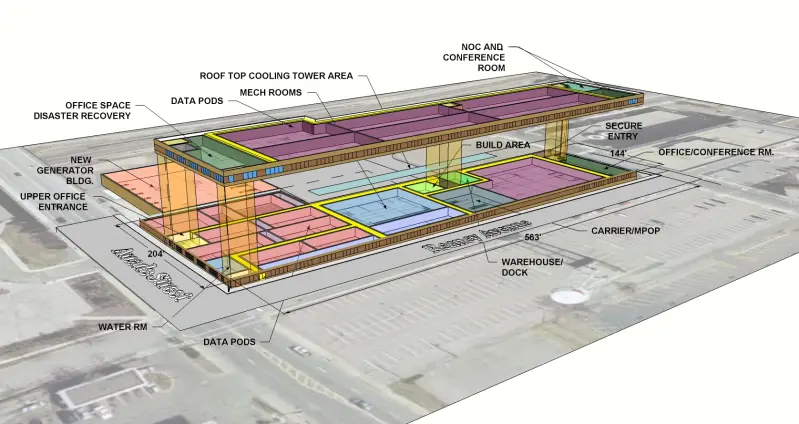

End-to-end project support
From construction documents and permitting to sourcing long-lead time materials like UPS systems and chillers, we guide you through every step. Our project management expertise ensures adherence to timelines, budgets, and quality standards for all types of data centre builds.
Phase 1: Assessment and Site Selection
- Define Goals: Determine capacity (MW), Tier level (Uptime Institute), and target audience.
- Site Selection: Choose a location with low natural disaster risk, robust fiber connectivity, and, most importantly, available power capacity.
- Load Study: Conduct studies (1–3 months) to ensure utility grid capacity.Autodesk +2
Phase 2: Planning and Design
- Conceptual Design: Create the layout, including server racks, cooling, and power distribution.
- Detailed Design: Finalize blueprints for structural, mechanical, electrical, and plumbing (MEP) systems.
- Permitting: Secure all legal, environmental, and building permits.Avigilon +4
Phase 3: Construction and Infrastructure Installation
- Site Preparation: Clear land, grade, and install foundational utilities.
- Structural Shell: Construct the building exterior, including reinforced walls, roof, and flooring to support heavy, dense equipment.
- Power Systems: Install substations, generators, UPS (Uninterruptible Power Supplies), and power distribution units (PDUs).
- Cooling Systems: Implement CRAC (Computer Room Air Conditioner) units, chillers, and raised floors or hot/cold aisle containment.
- Security & Safety: Install fire detection/suppression (e.g., gas-based) and biometric access control.
Your partner in critical infrastructure development
At DataCenterix, we bridge the gap between energy markets and real estate, making it easier to secure capacity and accelerate your data centre development. Our mission is to help operators scale with confidence by delivering sites that are power-ready, development-qualified, and structured for long-term success.

Navigating the complexities of data centre construction
The biggest headache clients face when building a new data centre is the sheer complexity and lengthy timeline, often 1.5 to 3 years. This includes everything from land clearing and foundation work to securing entitlements and managing lead times for critical equipment. Our service simplifies this by meticulously planning each step, from defining IT load requirements and target Tier levels (I-IV) to commissioning, ensuring a smooth transition from design to a fully operational facility.
The art and science of site selection for optimal performance

What makes our approach different is our deep expertise in data centre site selection, balancing performance, cost, and risk while considering data center developers requirements. We leverage geospatial analysis to identify locations in Texas & Nevada, that offer not just land, but strategic advantages: reliable power grid, proximity to fibre, natural disaster resilience, developers' rule of thumbs cost analysis and favourable incentives. We design for scalability, sustainability, and redundancy (e.g., dual substations, diverse fibre entry points), ensuring your facility is future-proof for hyperscale, colocation, office conversion to Edge data center or AI data centre needs.
Office Conversion to Data Center
Rule of Thumb
An edge data center within an existing office building, the rules of thumb shift because you are often constrained by the building's existing mechanical, electrical, and structural limits.
1. Power and Density
- Average Rack Load: Plan for 4–6 kW per rack as a baseline. If using AI or high-performance edge hardware, this can jump to 10–15 kW.
- Power Density: Aim for 100–200 Watts per square foot (WPSF) for the IT footprint.
- Expansion Buffer: Standard practice is to add 70% to the total calculated IT equipment power needs to account for future growth and support systems.
2. Cooling Requirements
- BTU Calculation: Every 1 kW of IT power requires approximately 3,412 BTU/hr of cooling.
- Cooling Margin: Use a 1.3x multiplier on the anticipated IT load to size your CRAC (Computer Room Air Conditioning) system, especially for rooms under 4,000 sq. ft.
- Rule of Thumb (Tons): 1 Ton of cooling for every 500 square feet is a rough preliminary estimate.
- Airflow: For high-density heat loads (300 WPSF), you may need 35–40 CFM of airflow per square foot.
3. Physical Space and Flooring
- Clear Height: Provide a minimum of 24 inches of clear height if using a raised-floor installation for air distribution.
- Rack Clearances: Maintain at least 1.5 inches of clearance between equipment and cabinet doors (front/back) to ensure adequate airflow. Doors should be at least 63% open (perforated).
- Floor Loading: Standard office floors may not support heavy server racks. Assess static floor loading capacity (lbf/ft²) early; high-density racks can exceed typical office limits.
4. Environmental Targets
- Temperature: Stick to the ASHRAE recommended range of 18–27°C (64.4–80.6°F).
- Humidity: Maintain relative humidity between 45% and 50% to prevent static buildup or condensation.
- Latency: For true edge performance, the facility should be within 50–100 miles of users to keep latency in the 1–2 millisecondrange.
5. Cost Estimation
- By Area: Use a rough budget of $1,000 per square foot for the facility build-out.
- By Load: Alternatively, budget $10 million per Megawatt (MW) of commissioned IT load.
CapEx Rules of Thumbs
1. Key Capital Expenditure (CapEx) Rules of Thumb
- Cost per Megawatt: Expect $7M to $12M per MW of commissioned IT load. For high-density AI-ready edge sites, this can jump to $20M+ per MW.
- Cost per Rack: A rough estimate for a Tier II facility is approximately $125,000 per rack.
- Cost by Tier (Redundancy):
- Tier I: ~$11,500 per kW.
- Tier III (Most Common): ~$23,000 per kW.
- Cost Breakdown:
- Electrical Systems: 40–45% of budget.
- Mechanical/Cooling: 15–20% of budget.
2. Industry Standard Calculators
For more precise project-specific numbers, use these industry tools:
- Schneider Electric Capital Cost Calculator: Best for early-stage planning. It allows you to adjust redundancy (N, N+1, 2N), rack quantity, and IT room area to see a "Rough Order of Magnitude" cost (+/- 20%).
- TierPoint Data Center Pricing Calculator:Compares the 10-year Total Cost of Ownership (TCO) of building your own facility versus using colocation.
- Expedient Build vs. Buy Calculator: Helps analyze potential savings by entering the number of cabinets and redundant power requirements.
3. Operational Expenditure (OpEx) Benchmarks
- Annual Operating Costs: Typically range from $10M to $25M for larger facilities, but for office-based edge sites, it is often calculated as $1,200 per square foot per year.
- Lifetime TCO: The total cost to own a single rack over its 10-year lifetime is approximately $120,000, split roughly 50/50 between CapEx and OpEx.
Create Your Own Website With Webador